What If the Problem Isn't the Whole Story?
“What Brings You In Here Today?“
Most People Start With the Problem
One of the first questions I ask during an intake session is simple:
"What brings you in here today?"
The answers are rarely simple. Some people describe work stress. Others talk about relationship conflicts, family tension, difficult decisions, or a problem that has been keeping them up at night. They often arrive carrying a detailed story of what happened, what they have already tried, and why those solutions have not worked.
Looking for the Right Answer
Many people come to therapy hoping for clarity. They want to know what to do next. They have already spent weeks, months, or even years trying to solve the issue on their own. They may have researched, planned, worried, analyzed, or sought advice from people they trust.
Sometimes there is an unspoken hope that I will have the answer they have not found yet.
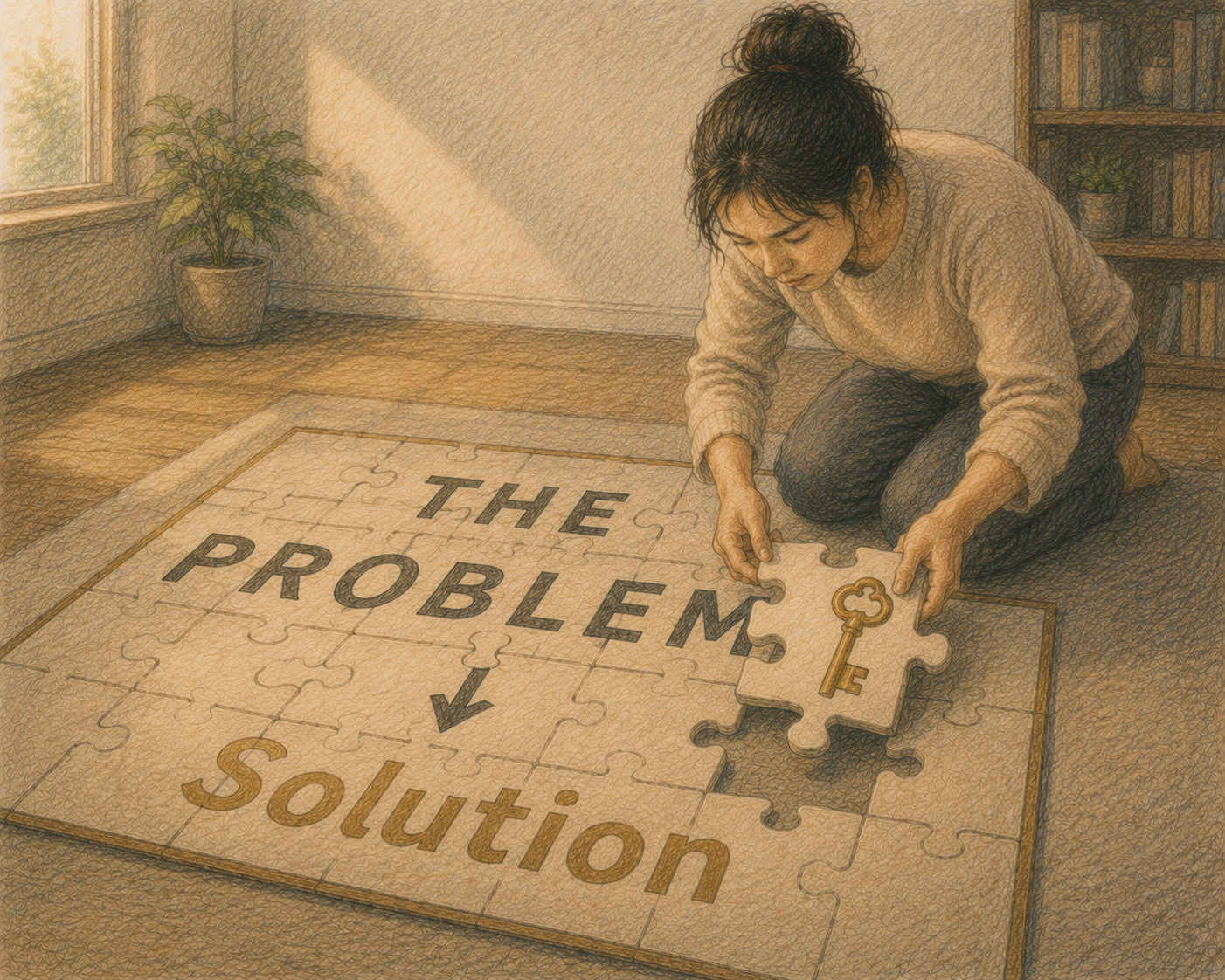
Sometimes we become so focused on solving the problem that we forget to explore the experience underneath it.
But Is the Problem the Whole Story?
The story matters. Understanding what happened is important. Yet over time, I have noticed that many people become experts in explaining the situation while remaining uncertain about their experience of it.
They know what happened.
They know what they should do.
But they have spent far less time asking:
What was happening inside me while all of this was happening?
What Happened Is Only One Layer
The Facts and the Experience Are Not Always the Same
The story of what happened matters. The facts help us understand the situation. But understanding an event is different from understanding its impact.
Two people can go through a similar experience and walk away with very different emotional realities. A presentation at work, a disagreement with a partner, a difficult conversation with a parent, or a major life transition may look similar from the outside. Yet what it feels like on the inside can be completely different.
One person may feel challenged and energized.
Another may feel anxious for days.
A third may find themselves replaying the conversation at night, unable to fall asleep.
Beyond the Story
This is where I often slow the conversation down in therapy.
Many people are very skilled at telling me what happened. They can walk me through every detail of the story, every conversation, every decision, and every attempt to solve the problem. Yet when I ask what the experience was like for them, the answer is often less clear.
Not because they are doing anything wrong.
Simply because many of us were never taught how to pay attention to our experience in the same way we learned to pay attention to problems.
We learned to understand situations.
We received less practice understanding ourselves.
The event is one layer of the story.
Our experience of it is another.
How Did We Learn to Respond This Way?
When Action Feels Easier Than Understanding
For many of us, responding to discomfort with action feels natural. When something feels wrong, our first instinct is often to figure out what to do next. We prepare, improve, fix, endure, plan, and push forward. Action gives us a sense of direction, especially when life feels uncertain.
This way of responding can be incredibly useful. It helps us solve problems, meet responsibilities, and navigate difficult situations. In many families, schools, and workplaces, these skills are encouraged and rewarded. We learn that effort leads to improvement and that persistence helps us overcome challenges.
What Receives Less Attention
Yet while we learn many ways to respond to problems, we may receive less guidance on how to understand our experiences.
When we feel anxious, we focus on preparing more.
When we feel insecure, we focus on performing better.
When we feel overwhelmed, we tell ourselves to keep going.
The focus often becomes how to function better rather than understanding what is happening inside us.
Over time, fear, shame, pressure, resentment, loneliness, or self-doubt may remain in the background, unnamed but still present.
Not because these feelings are unimportant.
But because the question that often receives attention is: "What should I do?"
The question that receives less attention is: "What am I experiencing right now?"
And sometimes that difference changes everything.
What Lies Beneath the Surface
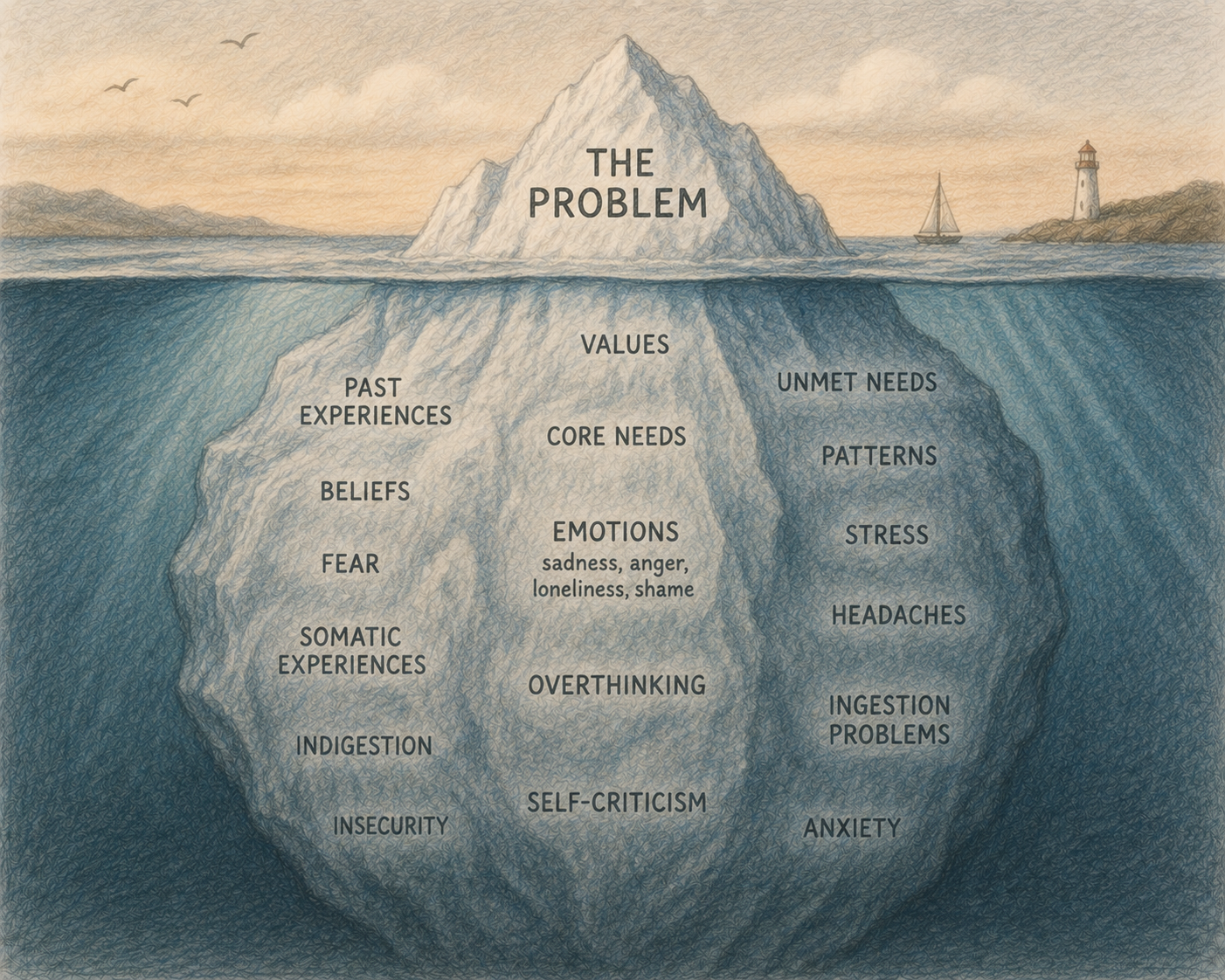
What we see on the surface is often only one layer of the experience.
More Than the Problem Itself
When we focus only on solving a problem, it is easy to assume the problem is the entire story. Yet many experiences contain layers that are not immediately visible.
Beneath a difficult conversation may be fear of rejection.
Beneath perfectionism may be a fear of failure.
Beneath overworking may be anxiety about falling behind.
Beneath a relationship conflict may be a longing to feel understood.
Like an iceberg, the part we see above the surface is often only one piece of the experience. Underneath may be emotions, beliefs, values, past experiences, unresolved hurts, or expectations we carry from earlier chapters of life. Sometimes we know what is beneath the surface. Often we do not.
The Body Often Carries What We Have Not Yet Understood
Even when we do not have words for an experience, the body may still respond to it.
Anxiety may show up as insomnia.
Pressure may appear as headaches.
Insecurity may show up as constant overthinking.
Stress may settle into the shoulders, jaw, stomach, or chest.
What we call a "sleep problem," a "stress problem," or a "concentration problem" may sometimes be connected to something deeper that has not yet been fully understood.
This is one reason somatic awareness can be so valuable. Instead of asking only how to get rid of a symptom, we become curious about what the body may be communicating.
Sometimes the body is not simply reacting.
Sometimes it is revealing an experience that has been asking for attention all along.
When the Problem Isn’t the Whole Story

Understanding your experience can create space for clarity, compassion, and calm.
Throughout our lives, many of us have become skilled at solving problems. We learn how to prepare, improve, endure, and keep moving forward. These skills are valuable and often help us navigate difficult situations.
But sometimes a problem is more than a problem.
Sometimes underneath the situation are emotions, fears, values, unmet needs, old experiences, or stories we have carried for years without fully recognizing them.
When this happens, solving the problem may help, but it may not address the entire experience.
Perhaps the next time you find yourself focused on fixing something, you might pause and ask:
What am I experiencing right now?
What emotions are present beneath the problem?
What is my body trying to tell me?
Where do I notice this experience in my body?
What might need understanding before it needs fixing?
We do not have to stop solving problems.
But we may benefit from becoming just as curious about our experiences as we are about our solutions.
Sometimes healing begins not when we find the answer, but when we learn how to listen.
Continue Exploring
If this article resonated with you, you may also be interested in:
When Scrolling, Watching, or Sleeping Still Doesn't Feel Like Rest — Why numbing and restoration are not the same thing.
Why Doesn't Every Vacation Feel Restful? — Understanding why time off doesn't automatically help us recharge.
Sometimes Productivity Is a Survival Strategy — Exploring how achievement, control, and productivity can become ways of coping with uncertainty.
If Your Inner Workaholic Never Lets You Rest (coming soon) — Understanding the protective part that keeps pushing you forward, even when you're exhausted.
What's in the Brain Is in the Body: Understanding the Mind-Body Connection (coming soon) — Learning how thoughts, emotions, and physical sensations continuously influence one another.
About the Author
Jingyi Chen is a Somatic Therapist serving adults throughout California via telehealth. She specializes in childhood trauma, family relationships, and Asian American mental health. Drawing from somatic therapy, Brainspotting, Internal Family Systems (IFS), and mindfulness-based approaches, she helps people better understand their emotions, reconnect with their bodies, and develop greater self-awareness, self-compassion, and emotional resilience.
