When Rest Feels Uncomfortable
The Unexpected Part of Slowing Down
I Thought Meditation Would Feel Calm
I recently joined a meditation group, expecting what many people probably expect: a chance to slow down, clear my mind, and feel a little more peaceful.
Instead, something unexpected happened.
As we shared our experiences afterward, one person talked about coughing throughout the meditation. Another noticed restlessness. I found myself sneezing, feeling goosebumps, or suddenly becoming aware of physical sensations I hadn't noticed before. Even when my body felt relatively still, my mind seemed anything but quiet. Thoughts kept appearing. Plans for the day resurfaced. My attention wandered more than I expected.
It made me wonder:
Why did slowing down seem to make me notice more instead of less?
When Quiet Didn't Feel Peaceful
Many people imagine that slowing down should immediately feel relaxing. So when stillness brings discomfort instead of relief, if you're doing something wrong.
But what if these experiences aren't signs that meditation isn't working?
What if they're simply signs that your body and mind finally have enough room to be noticed?
The discomfort wasn't the problem.

Slowing down doesn't always feel peaceful at first. Sometimes it simply gives our bodies room to speak.
It was the first thing I became aware of.
A Different Way to Understand It
That experience changed the question I was asking.
Instead of wondering, "Why can't I relax?" I became curious about something else:
What if I was simply noticing, for the first time, what had already been there all along?
That question invites a very different way of understanding what happens when life finally becomes quiet.
What Quiet Begins to Reveal
It Was Already There
When you slow down, noticing kicks in. You might catch a worry that's been sitting quietly, a thread of anxiety, or a restlessness you hadn't clocked until now.
It's tempting to assume slowing down created these things. It probably didn't. More likely, they've been there for a while — and being busy simply didn't leave room to notice them.
Awareness Often Arrives Before Calm
You usually notice these things because busyness no longer covers them. Slowing down doesn't create discomfort — it often reveals what staying busy has been helping you avoid.
This isn't a sign something's wrong with you. It's a sign your body has been running.
Two Kinds of Discomfort
Most days, you move from one task to the next, leaving little room to notice what's happening inside. Quiet simply gives those experiences room to emerge — and it tends to show up in two forms:
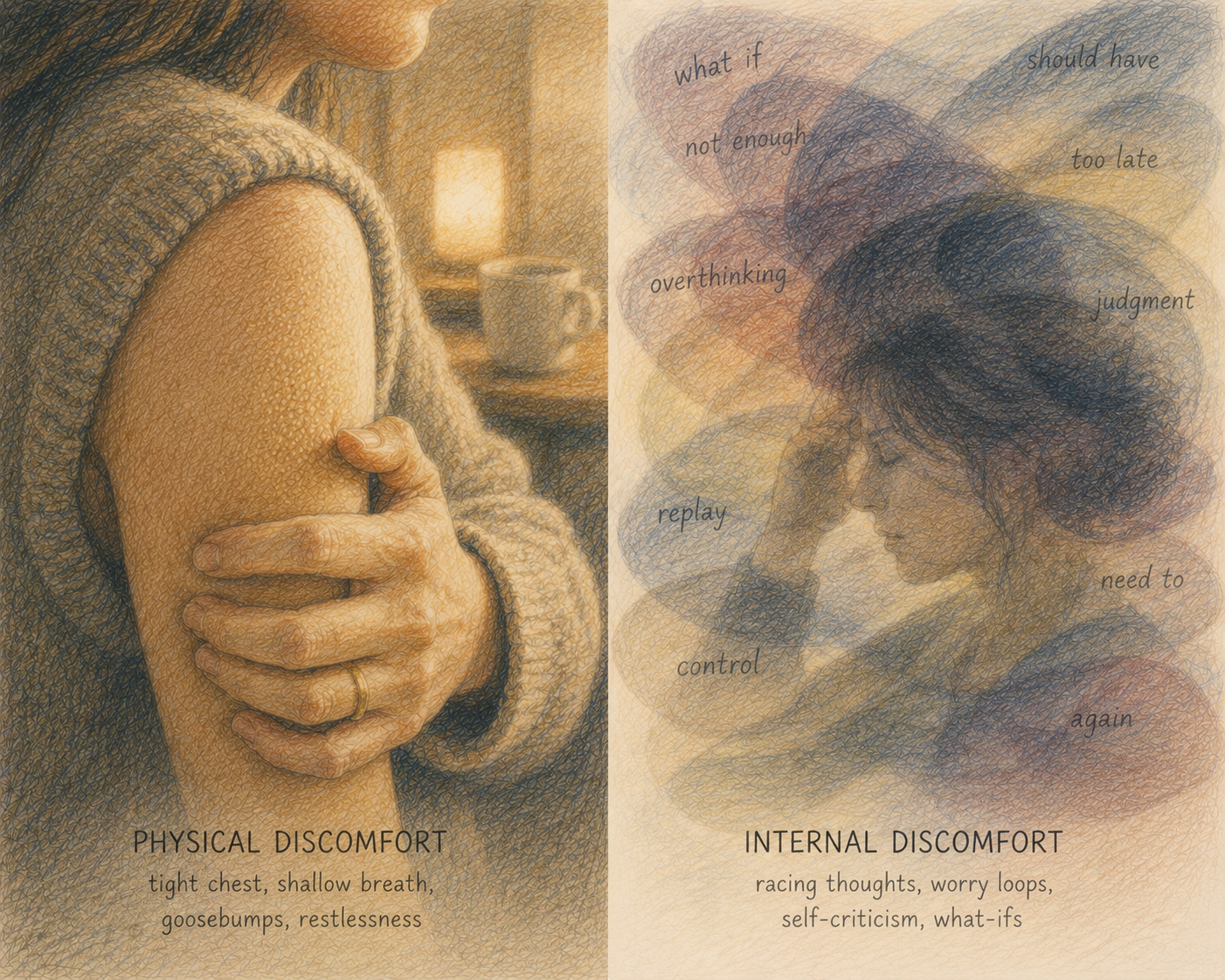
Discomfort doesn't always look the same. Sometimes it's physical. Sometimes it's quietly unfolding inside.
Physical
Goosebumps
An urge to move or shift position
Body temperature changes
Itchiness, sneezing, coughing
Internal
Planning or mental to-do lists
Self-criticism
Memories surfacing unprompted
Worries, emotions, or a feeling with no clear name yet
Neither kind means something is going wrong. Both are simply what becomes visible once the noise clears enough to hear it.
Not New — Just Noticed
If this discomfort has been there all along, quietly waiting under the motion of a busy day, then stillness didn't create the problem.
Stillness didn't create the music. It simply turned down the background noise enough for you to hear it.
Your Body Needs Time to Shift Gears
A Landing, Not a Stop
Imagine driving on the highway at full speed. You don't expect the car to go from seventy miles an hour to completely still the moment you touch the brakes. You take the off-ramp, gradually slow down, shift gears, and eventually come to a stop.
Your body often work in a similar way.
After spending hours solving problems, making decisions, responding to messages, and moving from one responsibility to the next, the nervous system doesn't instantly switch into a restful state simply because you sit down or close your eyes.
Your bodies need a landing, not just a stop.
The First Few Minutes May Not Tell the Whole Story
This helped me understand my meditation experience differently.
Those first few minutes often felt the busiest. I noticed sneezing, goosebumps, body sensations, and a mind that seemed determined to keep planning instead of resting. At first, it was tempting to think, This isn't working.
But something else happened when I stayed with it a little longer.
Around ten minutes in, my experience often began to change. My breathing softened. My body settled. The sensations didn't always disappear, but they became less overwhelming. The discomfort wasn't permanent—it had movement.
What I was experiencing wasn't my body malfunctioning.
It was my body gradually adjusting from constant doing to simply being.
What Happens If We Stay a Little Longer?
Sometimes the first few minutes of slowing down are part of the transition, not the destination.
The discomfort doesn't always mean something is wrong. It may simply be your body adjusting to a pace it hasn't experienced all day.
Rather than asking, "Why can't I relax?" perhaps you can become curious enough to ask:
"What happens if I stay here just a little longer?"
Sometimes the answer isn't immediate calm.
Sometimes it's simply discovering that your body knows how to slow down—they just need a little time.
Busy Was Never the Problem—It Was the Cover
What Has Staying Busy Been Doing for Us?
By this point, you might be wondering why staying busy can feel so much easier than sitting quietly with yourself.
Busyness has been doing more than helping us get things done.
For you, moving from one task to another leaves very little room to notice what's happening inside. There is always another email to answer, another errand to run, another problem to solve. The pace itself keeps your attention directed outward.
Sometimes busyness isn't about avoiding rest. It's about not yet knowing how to be with what quiet begins to reveal.
It may reduce your awareness of discomfort, create a sense of control, provide structure, or postpone emotions that don't yet feel easy to face. In other words, staying busy isn't always the problem. Sometimes it's been your body's best strategy for getting through the day.
Familiar Doesn't Always Mean Better
Your nervous system naturally prefer what feels familiar, even when it isn't particularly restful.
If your body has spent years living in constant motion, slowing down can feel surprisingly unfamiliar. At first, quiet may not register as peaceful—it may simply feel different. And unfamiliar experiences often invite caution before they invite ease.
This doesn't mean your body is resisting healing.
It may simply be trying to understand whether this new pace is actually safe.
Learning a Different Relationship With Quiet
You may have also absorbed messages that reinforce constant doing.
Don't waste time.
Keep improving.
Stay productive.
Earn your rest.
Over time, it's easy to begin believing that slowing down means falling behind, or that resting is something you have to justify.
That's why quiet can feel uncomfortable at first.
Not because rest is wrong, but because your body and your life have been teaching something different for a very long time.
The good news is that what the body has learned, it can continue learning.
Give It Ten Minutes
The Middle, Not the End
The next time you slow down and notice discomfort, perhaps you don't need to assume something has gone wrong.
What if that moment isn't the end of your attempt to rest?
What if it's the middle of it?
Sometimes your first instinct... distract yourself again—to check your phones, get back to work, or find something else to do. Not because we're weak or doing rest "wrong," but because discomfort naturally draws us toward familiar ways of coping.
Instead of immediately moving away, you might simply stay a little longer.
Becoming Curious Instead of Fixing
You don't have to make the thoughts disappear.
You don't have to force your body to relax.
You don't even have to understand everything that comes up.
All you need to do is notice.
What keeps returning?
What is your body feeling right now?
What emotions seem to be waiting quietly beneath the surface?
How does this discomfort change if you simply stay with it for another minute or two?
Curiosity often opens the door before change does.
Understanding tends to show up before ease does.
Staying With the Quiet
When I stayed with my own meditation practice for a little longer, I noticed something important. The discomfort wasn't permanent. My body gradually found its own rhythm, not because I forced it to relax, but because I gave it enough time to settle.
Maybe that's the invitation.
Not to become someone who always feels peaceful in the quiet.
But to discover that quiet isn't something to fear.
Sometimes healing begins not by doing more, but by staying present long enough to discover that your body has been trying to help you all along.

Quiet doesn't create what's inside us. It gives us enough space to notice it.
Continue Exploring
If this article resonated with you, you may also be interested in:
What If the Problem Isn't the Whole Story? — Sometimes the most important part of healing isn't solving the problem—it's understanding your experience.
Your Body Notices More Than You Realize — Learn how your body has been quietly paying attention long before you became aware of it..
Why Doesn't Every Vacation Feel Restful? — Discover why taking a break and feeling rested aren't always the same thing.
Too Triggered to Think? Simple Grounding Tools — , natural next step for a reader who now understands why stillness is uncomfortable and wants something to actually do with it.
About the Author
Jingyi Chen is a somatic therapist based in the Bay Area, working with adults navigating the lasting effects of childhood trauma. She believes discomfort in stillness isn't a sign something is wrong — it's often a sign the body has been running for a long time. Her work focuses on helping clients slow down safely, one small landing at a time, so the nervous system can begin learning that quiet doesn't have to feel unsafe.
